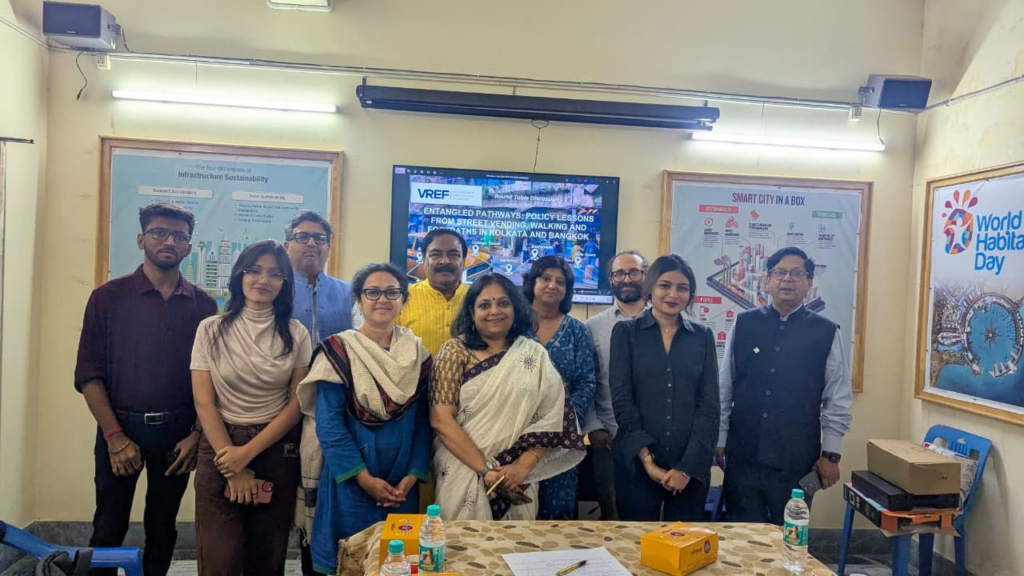
Shaktiman Ghosh, General Secretary of the National Hawker Federation (NHF) and a leader of the hawker movement, participated in a crucial roundtable discussion on a major international research project concerning the complex relationship of Kolkata’s streets, footpaths, and the coexistence of hawkers and pedestrians, as well as urban policy and the future. The discussion was held on the evening of October 11, 2025, at the Salt Lake office of the Institute of Town Planners, India.
This research project, titled “Entangled Pathways: Policy Lessons from Street Vending, Walking and Footpaths in Kolkata and Bangkok,” is funded by Sweden’s Volvo Educational Research Foundation (VREF). The primary objective of the project is a comparative analysis of urban policy, hawker systems, and pedestrian infrastructure on the footpaths of Kolkata and Bangkok. A team of researchers from India, Thailand, Australia, and New Zealand is working on this project.
In the invitation letter addressed to Shaktiman Ghosh, the project’s principal investigator and professor at Maulana Azad National Institute of Technology, Dr. Premjit Dasgupta, noted that his deep knowledge and experience regarding the history of hawking in Kolkata, urban policy, pedestrian infrastructure, and the changing context of civic management of footpaths would be extremely valuable for this research. The invitation requested him to initiate the discussion with a 10-15 minute presentation.
In his presentation, he shared his views on the history of hawking and walking in Kolkata, the socio-political context related to hawkers, the current organization and movement of hawkers, the current status of hawker- and pedestrian-friendly policies, related debates, and the future of hawking businesses.
The research team stated that Shaktiman Ghosh’s participation added a special dimension to this discussion. For a long time, he has not only led the fight for securing the rights of hawkers but has also presented to urban planners and policymakers the perspective of viewing footpaths as a living civic and economic system. Shaktiman Ghosh, a staunch believer that Kolkata’s footpaths are not just thoroughfares but centers of livelihood and social bonding, enriched the research project with the local context and ground realities through his remarks.
By participating in this meeting, a significant opportunity was created to present the direct voices and demands of the hawker community on an international research platform. With the voice of a leader like Shaktiman Ghosh joining this discussion, it is hoped that a bridge will be built between ‘high-level’ urban policy discourse and research and the grassroots struggles and realities.

Recent Comments