
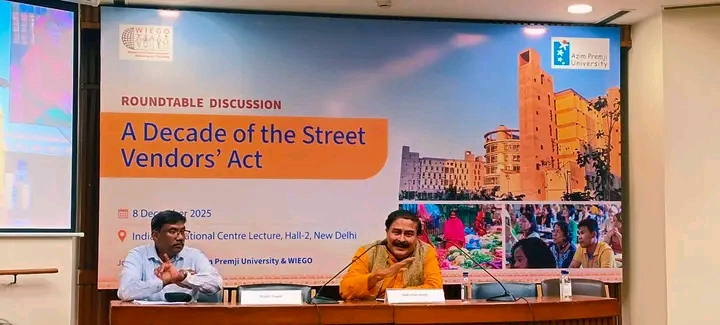
Event: Roundtable Discussion on a Decade of the Street Vendors (Protection of Livelihood and Regulation of Street Vending) Act, 2014
Organizers:Azim Premji University & WIEGO (Women in Informal Employment: Globalizing and Organizing)
Supported by:National Hawker Federation (NHF), Venue:Lecture Hall-2, India International Centre, New Delhi
Date:December 08, 2025
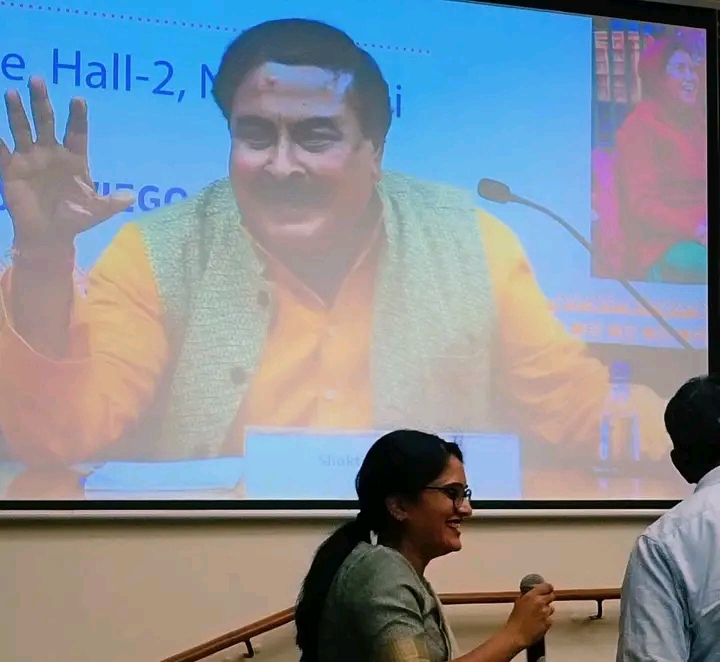
A landmark roundtable discussion was convened on December 8th, 2025, to critically reflect on ten years of the Street Vendors Act. Organized by Azim Premji University and WIEGO, the event brought together street vendors, Town Vending Committee (TVC) members, activists, researchers, policymakers, and urban planners to assess the journey of this pivotal legislation.
The discussion, set against the backdrop of a study surveying 1000 vendors across 10 Tier-2 cities, highlighted the stark dichotomy between the Act’s progressive intent and the persistent on-ground challenges faced by vendors. Participants engaged in robust dialogue on regulatory gaps, bureaucratic hurdles, and the implementation of schemes like PM SVANidhi, emphasizing the urgent need to bridge the gap between policy and lived reality.
Shri Shaktiman Ghosh’s Commanding Presence and Visionary Address
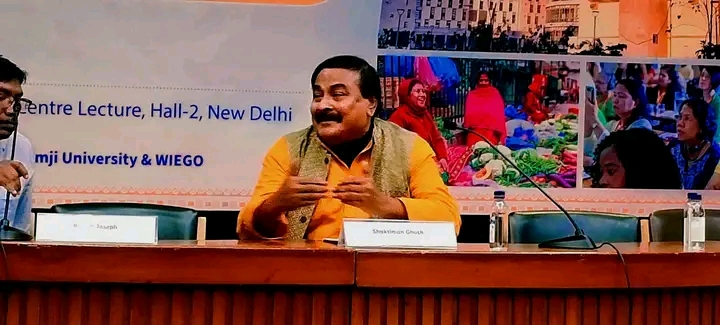
The culmination of the event was the powerful “Way Forward” session, steered by Shri Shaktiman Ghosh, the General Secretary of the National Hawker Federation (NHF). A stalwart champion of street vendors’ rights for decades, Shri Ghosh’s presence lent immense gravity and authority to the proceedings.
In his characteristically forthright and impassioned speech, Shri Ghosh provided a masterful synthesis of the day’s discussions, grounding them in the everyday struggles of millions of vendors. He lauded the Street Vendors Act as a historic victory born from relentless struggle but was unequivocal in highlighting its systemic failures in execution.
Key points from his powerful address included:
· A Reality Check on Implementation: He detailed the persistent issues of evictions, harassment, and the non-participatory functioning of many TVCs, stressing that “the law on paper must become the law on the street.”
· Beyond SVANidhi: While acknowledging PM SVANidhi as a step, he argued for comprehensive economic empowerment—including access to social security, dignified market spaces, and protection from arbitrary fines—that goes beyond micro-credit.
· A Call for Collective Action: Shri Ghosh emphatically called for a strengthened alliance between vendors’ organizations, researchers, and empathetic policymakers to create an unwavering accountability mechanism.
· A Vision for Inclusive Cities: He envisioned Indian cities where street vendors are not seen as a “nuisance” but as essential contributors to the urban economy and social fabric, entitled to dignity and space.
Shri Ghosh’s speech was not just a summary but a clarion call. He transformed the analytical discourse into a compelling roadmap for action, emphasizing that the next decade must be one of assertive implementation, not just reflection. His deep connection with the grassroots and his formidable articulation of their aspirations resonated powerfully with everyone present, reinforcing his role as the nation’s most prominent and trusted voice for the vending community.
The roundtable successfully fostered a multi-stakeholder dialogue crucial for re-invigorating the mission of the Street Vendors Act. The session anchored by Shri Shaktiman Ghosh and Rajesh Joseph of Azim Premji University ensured the event concluded on a note of determined optimism, with a clear directive for collaborative efforts to translate legal rights into tangible, dignified livelihoods.
The National Hawker Federation remains committed to leading this charge, ensuring the voices of street vendors remain at the center of all policy discussions and urban planning processes.
Recent Comments