
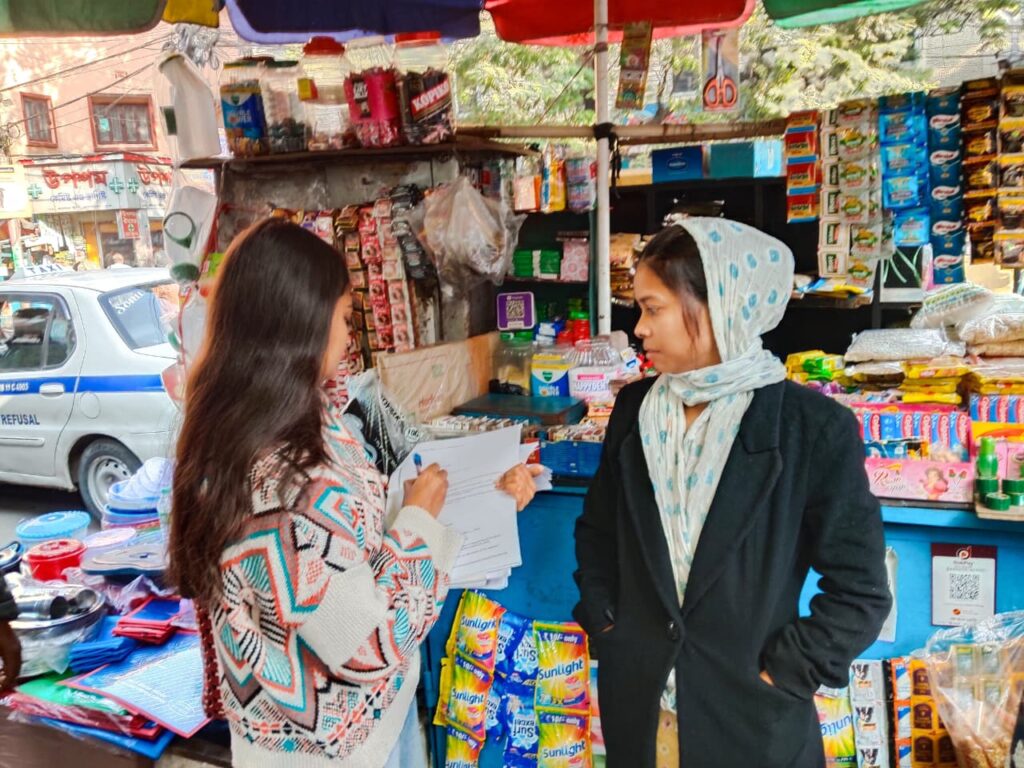
The National Hawkers Federation (NHF), Kolkata, was enriched by the dedicated efforts of Ms. Samraggi Choudhury, a Master’s student from the Tata Institute of Social Sciences (TISS), Mumbai, who completed a rigorous one-month internship with us from January 5th to February 5th, 2026. Her work was centred on a critical and timely issue: documenting the compounded vulnerabilities faced by women street vendors in Kolkata during intensifying heatwaves.
Samraggi’s internship was characterized by a deep dive into the intersection of climate change, informal labour, and gender justice. Her primary project involved conducting an in-depth survey titled “Heat Under the Open Sky: The Impact of Heatwaves on Women Street Hawkers in Kolkata.” Moving beyond theoretical frameworks, she engaged directly with 79 women vendors across various vending zones in the city, listening to their stories and systematically recording their challenges.
Through structured questionnaires and empathetic conversational interviews, Samraggi gathered vital data on the occupational, health, economic, and psychosocial impacts of extreme heat. Her methodology ensured that both quantitative data and powerful qualitative narratives were captured.
She meticulously documented cases highlighting how the lack of basic infrastructure—such as accessible toilets, permanent shade, drinking water, and affordable electricity—turns a heatwave from a weather event into a severe occupational hazard. Her work brought to light specific health issues like dehydration, urinary infections, and chronic fatigue that disproportionately affect women vendors.
Alongside her primary research, Samraggi responsibly assisted in organizing and archiving materials related to trade union activities and the broader struggles of informal sector workers, adding to our institutional memory.
Her interim findings powerfully argue that heatwaves act as a “multiplier of pre-existing inequalities,” exacerbating the socio-economic and gendered precarity of women in the informal economy. She highlighted how individual coping strategies are insufficient without systemic, gender-sensitive policy interventions.
Samraggi’s work goes beyond academic exercise. It provides the NHF with evidence-based, grounded research to strengthen our advocacy for climate-resilient urban planning. Her findings underscore the urgent need for policies that recognize street vendors, especially women, as essential economic actors deserving of dignity, protection, and a seat at the table in infrastructure decisions.
Her sincerity, analytical ability, and genuine sensitivity to labour and grassroots issues were evident throughout her tenure. She approached her work not as an external observer but as a committed learner and ally, embodying the spirit of engaged social research.
The NHF warmly commends Samraggi for her exceptional contribution. The insights from her survey will inform our ongoing campaigns for vendor rights, public health equity, and climate justice. We are confident that her career will be marked by the same dedication and impact she demonstrated during her time with us.
We extend our heartfelt thanks to Samraggi and wish her the very best in all her future academic and professional endeavors. Her month with us was a testament to the power of collaborative learning and action in the fight for a more just and resilient urban future.
Recent Comments